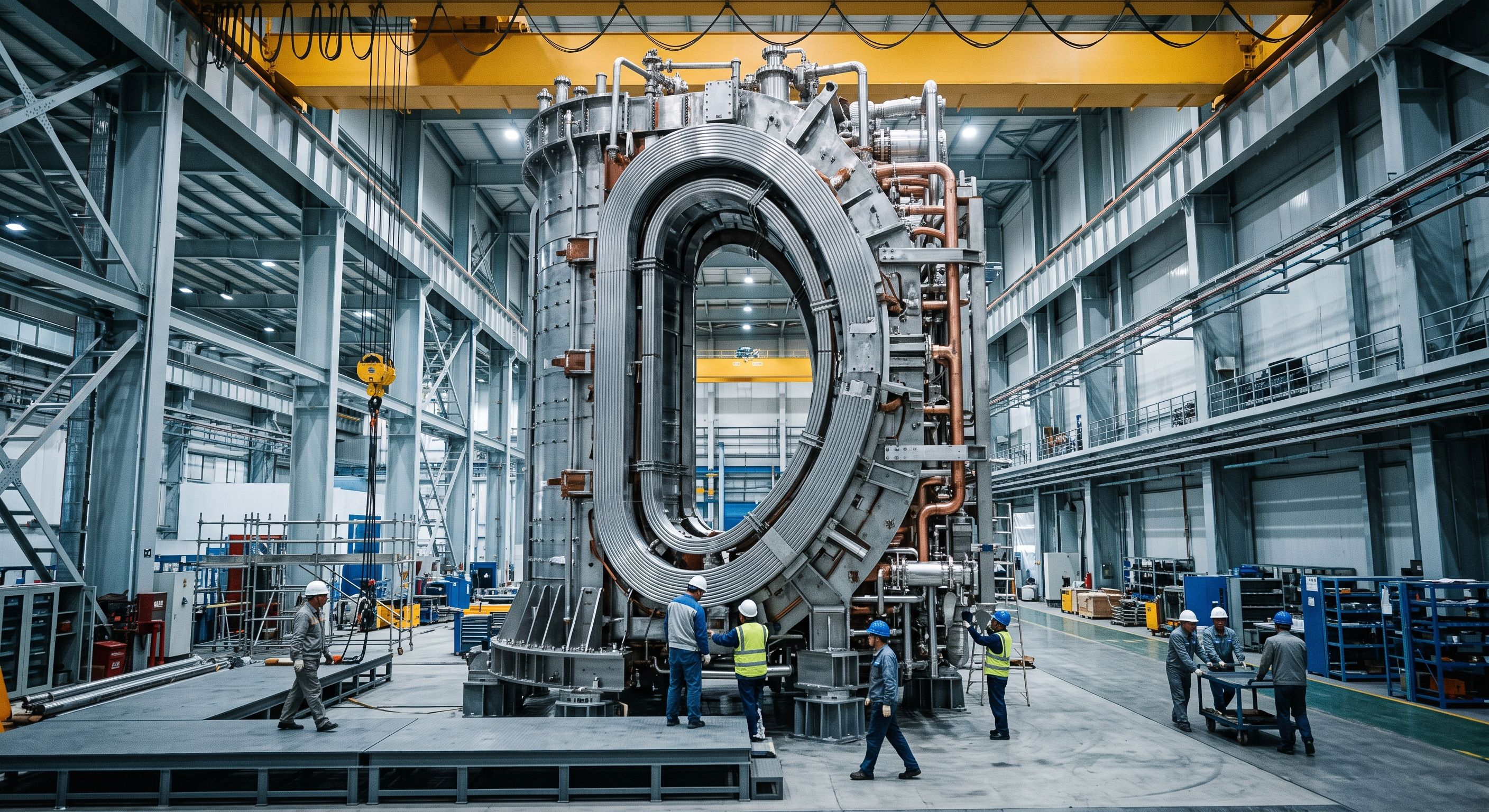
China Completes the World's Largest Fusion Magnet: A 582-Ton "Artificial Sun"

An Engineering Milestone That Brings the Energy of the Stars Down to Earth
China has made a decisive leap in the global race for controlled nuclear fusion: the Institute of Plasma Physics (ASIPP) at the Chinese Academy of Sciences announced in Hefei the completion and full-parameter testing of the largest toroidal field magnet ever built for a fusion reactor. The component — weighing 582 tons and stretching 21 meters long — will power the Burning Plasma Experimental Superconducting Tokamak (BEST) program, widely known as the country's next "artificial sun."
Unlike conventional electromagnets, this superconducting system operates with virtually zero electrical resistance when cooled to cryogenic temperatures. That allows it to sustain enormous currents while drawing far less energy — the essential condition for keeping a plasma stable when heated to over 100 million degrees Celsius, roughly six times the temperature at the Sun's core.
BEST: Beyond the EAST Experiment
The Experimental Advanced Superconducting Tokamak (EAST) — the "artificial sun" that already holds records for sustaining ultra-hot plasma — remains an active research platform. The new magnet, however, is not destined for EAST: it's designed for BEST, the next-generation reactor China is building alongside the CRAFT campus in Hefei.
BEST aims to demonstrate sustained burning plasma — plasma that keeps the fusion reaction going using a significant fraction of its own energy — and, in a later phase, generate electricity. Construction on the device kicked off in June 2023, with completion expected by late 2027, targeting fusion gain (Q ≥ 1) and useful power output in the range of 10 to 200 MW before the end of 2030.
Bigger and More Powerful Than ITER
According to Chinese researchers, BEST's toroidal magnet has a volume roughly 1.3 times larger than its counterpart designed for the international ITER project in France, and can store three times more magnetic energy. That capacity translates into stronger fields for confining plasma within the D-shaped geometry characteristic of tokamaks.
The development — which took about six years — drove advances in superconducting conductor manufacturing, structural engineering, cryogenic systems, and quench protection — the sudden loss of superconductivity. The program has also validated a high-temperature superconducting central solenoid, the "heart" of the tokamak that initiates and sustains the plasma current alongside the toroidal magnet.
Why Fusion Matters
Unlike fission, which splits heavy atoms, fusion joins light hydrogen isotopes together. During operation it produces no greenhouse gas emissions and generates far less long-lived radioactive waste than today's nuclear power plants. That's why governments and industry alike see it as one of the century's most ambitious long-term energy bets.
The announcement comes at a moment when drone footage of the 582-ton magnet spread widely across social media, turning a lab milestone into a public spectacle: a colossal, almost sculptural industrial structure that captures the sheer scale of China's ambitions.
The Race to 2030
Completing the magnet is not the same as commercial electricity. The full reactor still needs to be assembled, operated under extreme conditions for extended periods, and proven capable of stable net power generation. The ASIPP team itself places this achievement at roughly 80% of the technical path for the magnetic component — not the entire program.
Still, the message is clear: while the rest of the world debates AI models and digital markets, China is measuring its progress against the Sun. If BEST stays on schedule, this decade could be the one where fusion stops being talked about as a distant promise and starts being talked about in terms of real megawatts.