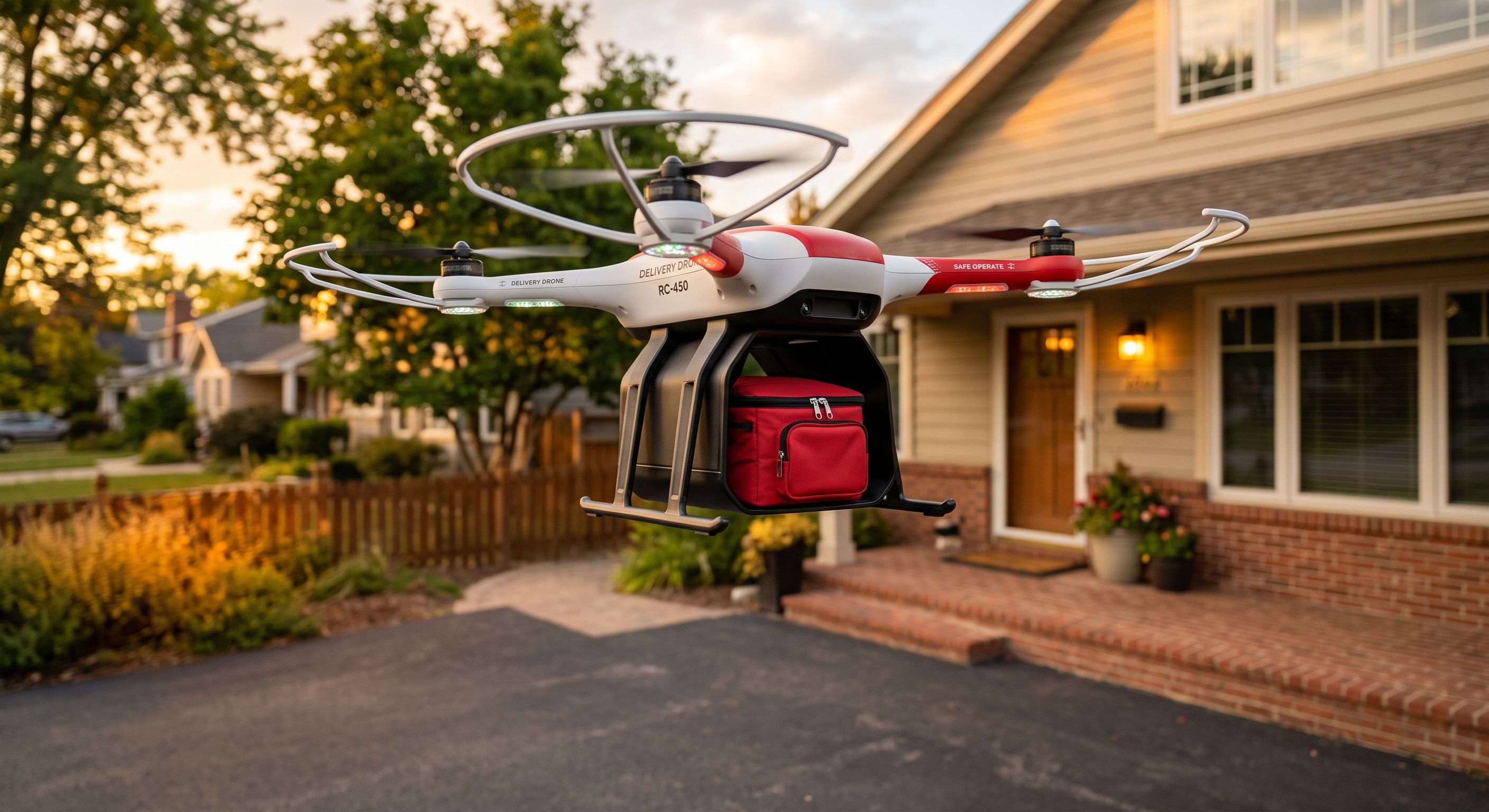
DoorDash Launches Its Own Drone Fleet: Your Burrito Will Be Coming in Hot from the Sky

Forget the delivery guy at your door: your next order might drop from the sky
DoorDash just made a bold move in its push toward logistics autonomy. The company announced DoorDash Air, its own drone delivery program, after securing an FAA Part 135 air carrier certification from the Federal Aviation Administration. With that clearance, it becomes the eighth drone operator in the country authorized to run a commercial aerial delivery service.
This isn't an isolated experiment or an empty marketing announcement. DoorDash Air is being launched under DoorDash Labs, the robotics and autonomy division that already developed Dot, the sidewalk delivery robot currently operating in cities across Arizona and in Fremont, California. According to the company, the aircraft is designed and manufactured in the U.S., with the majority of its components domestically sourced, and built specifically with local commerce in mind.
Pilot programs first, open skies later
Customers shouldn't expect burgers and burritos raining down from the sky everywhere anytime soon. The service will kick off with limited pilot programs; a company spokesperson said commercial deliveries are expected to begin this fall. In the first phase, drones will fly short distances and remain within the operator's line of sight.
To fly autonomously over wider areas, DoorDash will need additional Beyond Visual Line of Sight (BVLOS) approval — a certification already held by competitors like Amazon, Wing (from Alphabet), and Zipline. In other words: the Part 135 license opens the door, but a true large-scale rollout depends on clearing a second regulatory hurdle.
A system that picks between a human, a robot, or a drone
The least visible piece — and according to DoorDash, the most important one — is the software. The company developed the Autonomous Delivery Platform, a system that decides in real time whether an order should be sent with a human Dasher, a Dot robot, or a drone, based on distance, traffic, cost, and speed.
That routing logic targets a specific pain point in the business: three-to-five-mile deliveries, which currently take an average of 25% longer than shorter trips because they're harder to match with an available driver. Redirecting those routes to drones would free up Dashers to complete nearby orders more frequently and, in theory, boost their earnings.
Based on 2025 estimates, drone orders were completed in an average of 25 minutes, and some participating merchants saw a volume increase of nearly 30% during the pilots, with the bump holding steady for weeks.
Partners yes, dependency no
Despite building its own aircraft, DoorDash insists it's not leaving its current partners behind. It has been working with Alphabet's Wing since 2022 — first in Australia, then in the Dallas–Fort Worth area and metro Atlanta — and is keeping its partnership with Flytrex intact. The corporate message is clear: they want more operators, not fewer.
Co-founder and chief product officer Stanley Tang framed the robotics expansion as a response to customer problems, not a tech showcase:
"We didn't start from the question: what's the coolest autonomous technology we could build? We started from first principles: what's the real customer problem that needs to be solved?"
What's at stake
With more than 10 billion orders delivered throughout its history, DoorDash is no longer just competing for a share of the food delivery market — it's competing to own the multimodal logistics layer — people, ground robots, and its own aerial fleet — that determines how local commerce moves.
DoorDash Air isn't replacing the human delivery driver just yet. It's repositioning them as one option within a network that aims to be faster, cheaper to run, and less dependent on driver availability. If the fall pilots deliver and BVLOS approval comes through, drone delivery will stop being a tech conference pipe dream and become just another option in the app.